
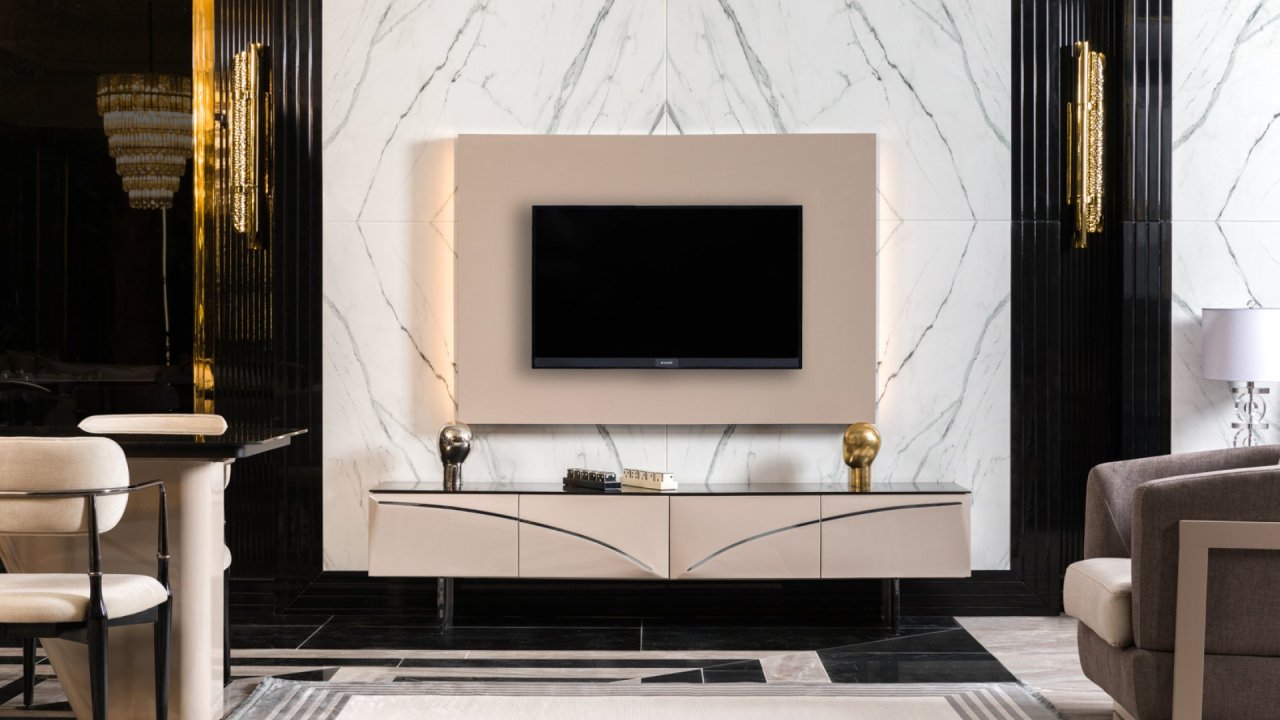
Classic Furniture and Modern TV Unit Decoration: The Focal Point of Your Living Room
The television area is one of the most noticeable parts of a living room. Even an attractive TV unit can become impractical when the screen size, unit dimensions, sofa positions, and walking areas are not planned correctly. For this reason, a TV unit should be selected according to both its design and the household’s daily habits.
Classic furniture and modern TV unit decoration help balance elegant, decorative furniture with a simpler entertainment area. A modern TV unit with clean lines can be used in a living room furnished with a classic sofa set. Harmony between these two styles can be achieved through coordinated colors, handles, legs, surfaces, and accessories.
Before making a purchase, consider the dimensions of the unit, television size, viewing distance, storage requirements, electrical socket positions, and cable routes.
What Does a Modern TV Unit Include?
A modern TV unit may consist of more than a single television stand. Depending on the design, it can include a lower cabinet, wall shelves, closed cupboards, drawers, bookcase sections, and decorative upper modules.
Not every module has to be used in every living room. A simple lower cabinet and one wall shelf may be sufficient for a small room. In a spacious living room, closed cabinets, shelves, and tall side modules can create a more balanced arrangement.
SRC Furniture’s modern TV unit collection includes options designed for different room dimensions and decoration requirements. When comparing models such as Garda, Kano, Porto, Tokyo, Focus, Helsinki, Line, and Stockholm, consider their dimensions, module contents, and storage features.
Do not assume that every item displayed in the product image is included in the standard set. Before ordering, confirm whether the lower cabinet, wall shelves, and side modules are included or sold separately.
How Should TV Unit Dimensions Be Determined?
Before choosing a TV unit, measure the width and height of the wall where it will be placed. Doors, windows, electrical sockets, internet connections, radiators, and air conditioners should be included in the measurements.
The unit does not have to cover the entire wall. Leaving some empty space on both sides can make the television area feel more open. A small unit may look disproportionate under a large screen, while an oversized model can make the room feel narrow and restrict the placement of other furniture.
A lower cabinet that is wider than the television generally creates a more balanced appearance. However, the exact dimensions should be determined according to the screen size and room layout. The height of wall-mounted modules should also be planned based on the seating position.
Do not forget to consider the depth of the skirting boards. They may prevent the unit from sitting directly against the wall. If tall modules will be fixed to the wall, the wall structure and its suitability for installation must also be checked.
At What Height Should the Television Be Positioned?
Placing the television too high or too low may cause neck and eye discomfort during extended viewing. The middle of the screen should be close to the natural eye level of a person sitting on the main sofa.
To find the correct height, sit in the primary viewing position and measure your eye level. Seat height, seat depth, and the user’s preferred viewing position will influence the result.
If the television will be mounted on the wall, leave sufficient room underneath for a soundbar, receiver, or other devices. When the TV is placed directly on the cabinet, check that the surface is wide and strong enough to support it safely.
Positioning the screen according to the center of the wall alone may not produce a comfortable result. It should be aligned with the seating arrangement and the actual viewing position.
Why Are Screen Size and Viewing Distance Important?
The television size should be considered together with the room dimensions and the distance between the screen and sofa. A screen that is too large for a short distance may cause eye fatigue. A small screen may provide an unsatisfactory viewing experience in a spacious living room.
The ideal distance can vary depending on screen resolution, television technology, and personal habits. Therefore, the manufacturer’s recommendations should also be considered rather than relying only on general measurement charts.
When selecting a TV unit, it may be helpful to consider whether you might purchase a larger television in the future. If the cabinet and wall arrangement are planned too narrowly for the current screen, the unit may need to be replaced later.
How Can Cables Be Kept Organized?
Hidden cables are one of the most important details in a clean and modern television area. The TV, modem, satellite receiver, game console, sound system, and other electronic devices can create a large number of visible cables.
Before ordering, check whether the back of the unit includes cable management openings. Electrical connections and ventilation should be considered for devices placed inside closed cabinets.
Cables should not become trapped or bent sharply behind the furniture. Electrical sockets positioned in an inaccessible area behind the unit may make maintenance and daily use more difficult.
Cable channels, openings within the furniture, or concealed wall installations can create a cleaner appearance. If work will be carried out inside the wall, the positions of electrical and internet lines should be identified beforehand.
How Should Storage Be Planned?
A TV unit is not only a piece of furniture for supporting the television. Closed cabinets and drawers can store remote controls, chargers, gaming equipment, books, magazines, and various living-room items.
Open shelves can be used for decorative accessories, but placing too many objects around the screen may make the area appear cluttered. Closed cabinets create visual order and keep less frequently used items out of sight.
Drawers and doors should not hit the coffee table or other furniture when opened. There must be sufficient clearance in front of the unit for daily use. In homes with children, tall shelving and heavy decorative items should be positioned securely.
Storage requirements should be determined according to both current belongings and electronic devices that may be added in the future.
How Can a Modern TV Unit Be Combined with Classic Furniture?
When planning classic furniture and modern TV unit decoration, every item does not need to share the same pattern or craftsmanship. A more successful result can be achieved by identifying common colors and material details.
The wood tone used in a classic sofa set can be repeated on the legs or handles of the TV unit. Metal details on the sofas can be coordinated with the unit’s handles. Transitional colors such as cream, beige, brown, walnut, and warm gray make combining the two styles easier.
Using a TV unit with numerous shelves and decorative details opposite a highly ornamental classic sofa set may make the room feel visually tiring. A simpler unit with clean lines can balance the details of classic furniture.
Those who want a more traditional television area can explore the classic TV unit collection. Comparing classic and modern categories can help determine the right level of decoration for the living room.
Coordinating a TV Unit with Modern Sofa Sets
In a living room with modern sofas, compare the lines, leg structures, and colors of the furniture. Combining curved seating with strongly geometric forms creates contrast. This can be visually interesting when planned carefully, but the colors and proportions must remain balanced.
The TV unit, coffee table, and sofa set do not have to come from the same collection. Pieces from a similar color family or with comparable leg heights and metal details can be used together.
Those planning to update the entire living room can compare the TV units with SRC Furniture’s modern sofa sets.
Balancing the Wall Color and TV Unit
When choosing the unit’s color, consider the wall and the amount of natural light in the room. A dark TV unit on a light wall can create a strong focal point. In small or dimly lit rooms, light-colored furniture may produce a more spacious appearance.
Highly patterned backgrounds behind the television can become distracting during viewing. If wall panels, wallpaper, paint effects, or decorative coverings will be used, they should not compete visually with the screen.
Wall molding or warm metallic details can introduce a classic influence. However, the TV unit, wall panel, accessories, and lighting should not all be highly decorative at the same time.
In classic furniture and modern TV unit decoration, the wall can serve as a calm background that connects both styles.
How Should Lighting Be Used Around a TV Unit?
Very bright or direct lighting around the television may reduce viewing comfort. Ceiling lights and spotlights reflected on the screen can negatively affect picture visibility.
Soft, indirect lighting behind the television may reduce the contrast between the bright screen and a dark wall. Shelf lighting can also highlight selected decorative items.
Lighting cables and control systems should be planned before the TV unit is installed. Cables added later may disrupt the clean appearance. If the wall unit includes integrated lighting, ask about its electrical connection and maintenance requirements.
TV Unit Ideas for Small Living Rooms
In small living rooms, simple lower cabinets may be more suitable than large units with numerous modules. Furniture with raised legs or wall-mounted designs exposes more of the floor and can make the area feel more open.
Light colors, a limited number of shelves, and uncluttered designs are practical choices for small rooms. When additional storage is required, closed cabinets and drawers may be more effective than multiple open shelves.
There should be enough space between the TV unit and coffee table for comfortable movement. Choosing a model without measuring the opening distance of drawers and doors may cause difficulties during everyday use.
For wall-mounted units, the construction of the wall must be checked. Heavy modules should be secured with appropriate fixtures to ensure safety.
How Should a TV Wall Be Arranged in a Large Living Room?
In a spacious room, a small television stand may look inadequate on a wide wall. The lower cabinet can be supported with side cupboards, a bookcase, decorative shelves, or wall panels.
However, the entire wall does not need to be covered with furniture. Empty spaces allow the interior to breathe. The television and unit should be centered according to the seating group rather than the wall alone.
In an open-plan room, the TV unit can act as a focal point that defines the seating area. Connecting it with the dining area through shared colors or materials helps different sections feel like parts of the same living space.
Viewing Modern TV Units at MASKO
TV units can be researched online, but viewing their real colors, surfaces, dimensions, and storage layouts in person can make the purchasing decision easier. Modern and classic models can be examined at the SRC Furniture showroom in Istanbul’s MASKO Furniture City.
During a showroom visit, check the drawers, cabinet doors, shelves, cable openings, and module connections. Take note of your television dimensions and wall width before visiting. Photographs of the wall and living room can also help when comparing suitable options.
More information about the location and furniture shopping is available in the MASKO Furniture City article.
What Should Be Checked When Ordering from Another City?
When ordering a TV unit from Ankara, Izmir, Bursa, Antalya, or another city, request written confirmation of the complete product dimensions and included modules. If the design includes wall-mounted components, ask whether installation is included.
Clarify the following details before ordering:
- Width, height, and depth of the lower cabinet
- Modules included with the product
- Available colors and surface options
- Compatibility with the television size
- Whether wall installation is included
- Availability of cable management openings
- Production and delivery time
- Intercity transportation conditions
- Upper-floor delivery and assembly
- Procedure for damaged components
Check the packaging at delivery and test all doors and drawers after assembly. The balance and connections of wall-mounted modules should also be inspected.
Conclusion
Classic furniture and modern TV unit decoration create a balanced transition between the decorative and simple elements of a living room. For the best result, begin by measuring the wall and determining the television size, viewing distance, and sofa positions.
Storage areas, cable routes, socket locations, and the space required for opening modules are important for daily use. When colors and material details are coordinated with classic seating, a modern TV unit can become a natural part of the overall decoration.
Different models can be viewed at the SRC Furniture showroom in Istanbul’s MASKO Furniture City. Delivery and installation conditions for Ankara, Izmir, Bursa, Antalya, and other cities should be confirmed before ordering.
Frequently Asked Questions
Should the TV unit be wider than the television?
A lower cabinet that is wider than the television generally creates a balanced appearance. However, the appropriate dimensions depend on the screen size, wall width, and room layout.
At what height should a television be positioned?
The middle of the screen should be close to the natural eye level of a person sitting on the main sofa. Seat height and viewing position should be considered during measurement.
Which type of TV unit is suitable for a small living room?
Simple lower cabinets, light colors, and closed storage areas can be practical for small rooms. Numerous shelves and large side modules may make the space appear narrower.
Can a modern TV unit be used with classic sofas?
Yes. The two styles can be combined through coordinated wood tones, handle colors, leg designs, and shared neutral shades.
How can TV unit cables be hidden?
Cable management openings, cable channels, or properly planned concealed wall installations can be used. Electrical and internet connections should be planned before installation.
Are wall-mounted TV units safe?
They can be safe when appropriate fixtures are selected for the wall type. The wall structure and weight of the modules must be evaluated before installation.
 ARA
 CANLI DESTEK
 HARİTA