
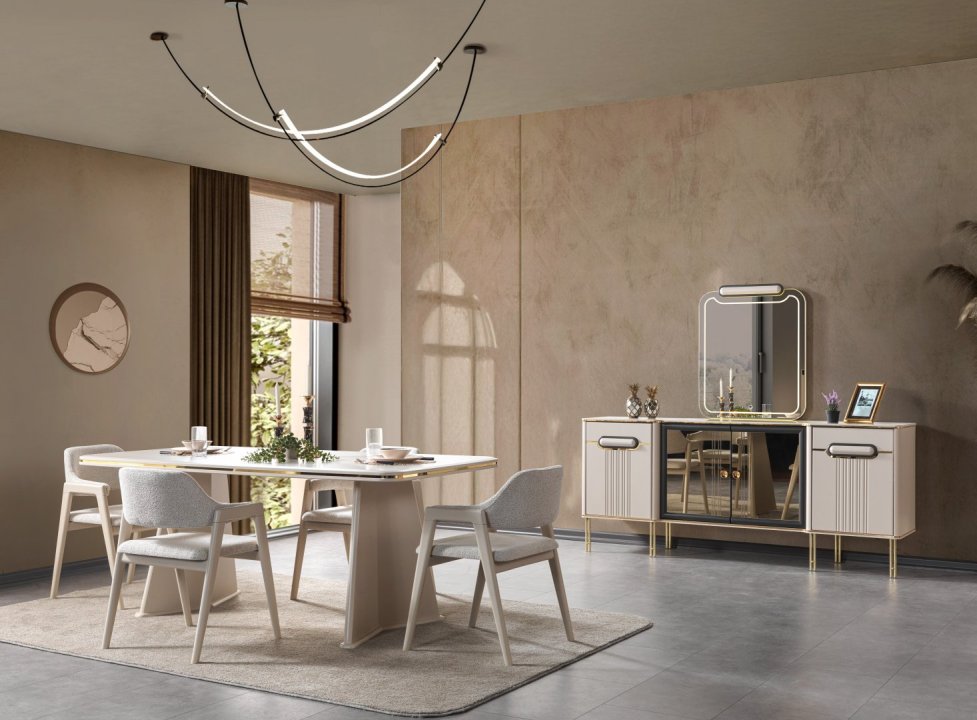
Harmony of Dining Table, Chairs, and Console in Dining Room Decoration
Harmony between the dining table, chairs, and console depends not only on choosing pieces from the same design style, but also on ensuring that they complement one another in terms of size, color, material, seating comfort, and available space. While the dining table forms the center of the area, the chairs determine everyday comfort, and the console supports storage and visual balance. Choosing these three elements in the right proportions helps create a dining area that is both functional and well organized.
Where Should Harmony in Dining Room Decoration Begin?
Dining room planning should usually begin with the placement of the table. This is because the dining table is one of the largest pieces of furniture in the space and directly determines where the chairs and circulation areas can be positioned.
There should be enough room around the table to pull out chairs, sit comfortably, and serve food. The console can be placed along the same wall as the table or in a quieter section of the dining area.
Sarıçam Mobilya’s existing dining room content also emphasizes that table dimensions, chair comfort, console placement, and circulation space should be considered together.
How Should Dining Table Size Be Determined?
The first criteria when choosing a dining table are the number of people it needs to accommodate and the size of the room. A large dining table can look balanced in a spacious interior, while in a smaller area it may restrict movement.
When selecting a table for four, six, or eight people, it is important to consider not only the size of the tabletop but also the amount of space the chairs will occupy when pulled back.
Rectangular tables can be easier to position in long dining areas, while square or round tables may offer more flexible layouts in compact spaces.
Choosing a table that fits the architecture of the room makes all subsequent decorating decisions easier.
How Should Chair Dimensions Match the Dining Table?
The height, width, and backrest structure of the chairs should be evaluated in relation to the dimensions of the table.
There should be sufficient distance between the seat height and the tabletop. If the chairs have armrests, it is also important to check whether the armrests can fit comfortably under the table.
Wide-backed and substantial chairs can look balanced with large dining tables. With smaller tables, however, oversized chairs can make the space feel unnecessarily crowded.
For this reason, the table and chairs should be tested together not only visually but also in real use.
Why Is Chair Comfort Important?
Dining chairs are not always used for short periods. During long dinners, family gatherings, or when hosting guests, people may remain seated for extended periods.
For this reason, the backrest angle, cushion construction, seat width, and upholstery material should all be evaluated.
A chair that is too firm or too upright may become uncomfortable during longer meals. On the other hand, an excessively soft seat may make it difficult to maintain the balanced sitting position required at a dining table.
Comfort should always be considered together with table height.
Do the Dining Table and Chairs Have to Be Made from the Same Material?
No. The dining table and chairs do not have to be made entirely from the same material.
An upholstered chair can be paired with a wooden table. Metal or decorative details can also be repeated in small amounts to create a visual connection.
The important point is that there should be at least one common element between the pieces. This connection can be created through wood tone, fabric color, metal details, or design language.
For example, when a dark walnut table is paired with cream-upholstered chairs, using a similar wood tone on the chair legs can help create visual unity.
What Is the Purpose of a Console in a Dining Room?
A console provides both storage and a decorative surface.
Dinnerware, serving plates, table linens, or less frequently used kitchen accessories can be stored inside the console. This prevents these items from accumulating around the dining table.
The top surface of the console can be used for a mirror, vase, decorative object, or lighting.
However, the console should not be considered only as a decorative piece. It should also be evaluated as functional furniture that meets the storage needs of the dining room.
How Should Console Size Be Chosen?
The width of the console should be determined according to the available wall space and the scale of the dining table.
A console that is too large may compete visually with the table, while a console that is too small may look out of proportion on a wide wall. There should also be enough space in front of the console to open doors and drawers comfortably.
There should be sufficient circulation space between the console and the dining table so that people can move easily while serving food.
For this reason, before purchasing furniture, it is important to measure not only the wall width but also the actual movement space that will remain after the furniture is positioned.
Do the Console and Dining Table Have to Be the Same Color?
No. They do not need to be exactly the same color.
Different shades from the same wood family or shared design details can be used. For example, if the table is made from dark wood, the console can use a lighter shade of the same wood family.
In dining rooms that combine lacquered, metal, or stone-look surfaces, repeating one of these materials in small amounts across the other furniture pieces is usually enough.
This approach preserves visual unity while creating a more layered interior.
How Should Color Harmony Be Created?
The dining room color palette should not be determined by the furniture alone. Walls, flooring, curtains, and lighting are also part of the same composition.
If a dark wood dining table and console are used, light upholstery on the chairs can create an effective contrast.
With lighter furniture, stronger tones can be introduced through chair upholstery.
The main goal is not to make every piece the same color, but to create a relationship between the main tone and complementary shades.
What Should You Consider When Choosing Chair Fabric?
Chair upholstery is important not only in terms of color but also in everyday use.
Because spills and stains are more likely in dining areas, ease of maintenance should be considered. Very light colors may require more frequent cleaning.
The texture of the fabric should also relate to the surfaces of the table and console. In a dining room with detailed wood craftsmanship, heavily patterned fabric may increase visual density.
With simpler dining tables and consoles, textured chair fabric can add more character to the interior.
How Should Lighting Above the Dining Table Be Chosen?
The chandelier or pendant light above the dining table is one of the focal points of the dining area.
Positioning the lighting fixture along the same axis as the table creates visual balance. A fixture that is too small may lose its impact above a large table, while an oversized fixture may unnecessarily block the view.
The height of the fixture is also important. It should not obstruct the view of people sitting at the table or cast harsh light directly onto their faces.
Warm or neutral lighting can help wood and fabric tones appear more natural.
Can a Mirror Be Used Above the Console?
Using a mirror above the console can offer both decorative and spatial benefits.
Especially in narrow dining areas or rooms with limited natural light, a mirror can help distribute light more effectively throughout the space.
The width of the mirror should be proportional to the console. A very small mirror may look insignificant above a wide console, while an oversized mirror may dominate the wall.
The color of the mirror frame can also connect with the wood or metal details of the console.
How Should the Dining Table Be Decorated?
The dining table should remain functional for everyday use. Instead of using many decorative objects, it is better to choose a few pieces that can be removed easily when needed.
On long tables, several smaller decorative objects can be grouped together instead of using one large centerpiece. However, arrangements that are too tall and block eye contact between people should be avoided.
A vase, decorative bowl, or simple table textiles may be enough.
Table decoration should not completely cover the natural surface of the furniture.
How Can Accessory Balance Be Created on the Console?
The console is usually one of the most suitable surfaces for accessories in a dining room.
An asymmetrical arrangement can be created by placing a tall vase or table lamp on one side and lower objects on the other.
For a more symmetrical look, two similar lamps or decorative objects can be placed at both ends of the console.
However, filling the entire console with accessories reduces usable surface space. Leaving some empty space can be useful when temporary serving items need to be placed there.
How Can the Dining Area Be Defined in an Open-Plan Living Room?
If the dining area and living room share the same space, they do not need to look completely different. Instead, a connection can be created through shared colors and materials.
For example, the wood tone from the sofa set can be repeated on the dining table legs, or a color used in the sofa upholstery can be introduced in the dining chair fabric.
A correctly sized rug under the dining table or a separate lighting fixture can help visually define the dining zone.
This allows the seating and dining areas to maintain separate functions while preserving a consistent overall design language.
Why Is Circulation Space Important in Dining Table, Chair, and Console Placement?
It is not enough for a dining room to look attractive. People also need to be able to move comfortably during daily use and while serving food.
When a chair is pulled back, it should not hit the wall, console, or another chair.
Opening the console doors or drawers should not interfere with the use of the chairs.
For this reason, furniture placement should take into account not only the dimensions of each piece when closed, but also the amount of movement space required during actual use.
 ARA
ARA
 CANLI DESTEK
 HARİTA