
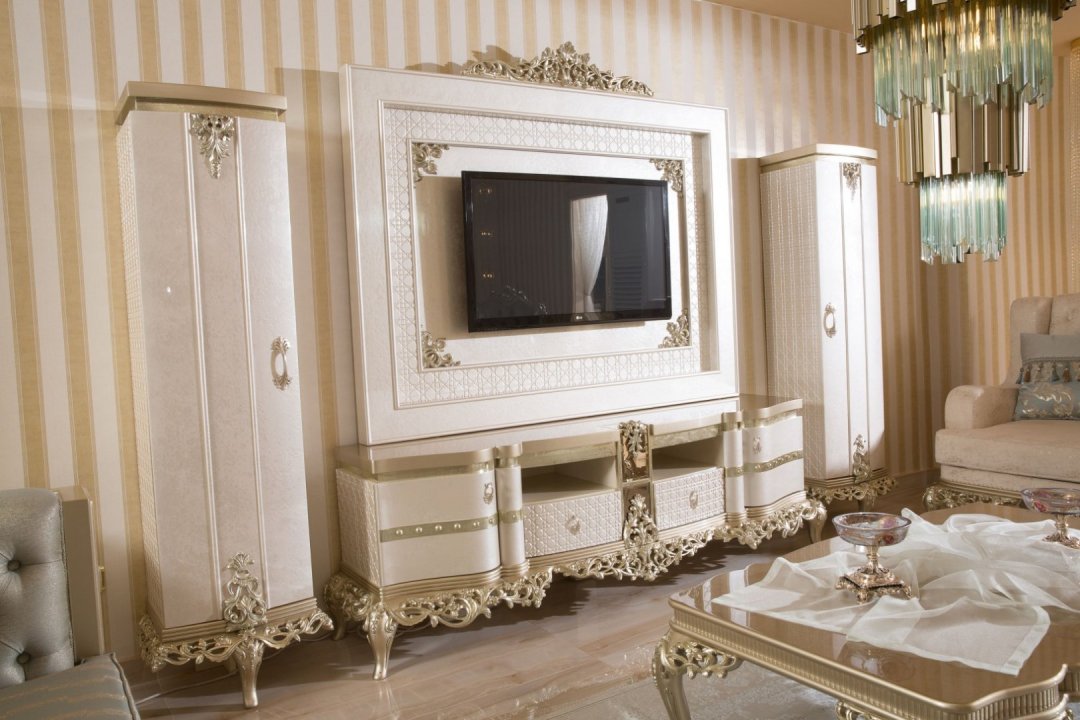
How to Evaluate Design and Storage Space When Choosing a TV Unit
When choosing a TV unit, design and storage space should be evaluated together. It is important not only for the unit to match the living room decoration, but also to provide enough space for the television, media devices, cables, remote controls, and everyday items. The right TV unit should suit the dimensions of the wall, be proportional to the television screen, meet storage needs, and avoid unnecessarily restricting movement in the living room.
Why Should Design and Function Be Considered Together in a TV Unit?
A TV unit is one of the most visible pieces of furniture in a living room. Since the television is usually positioned opposite the sofa set, the form, color, and material of the unit directly influence the overall character of the room.
However, choosing a model based only on appearance is not enough. A unit may look attractive but become impractical if it does not provide suitable space for remote controls, gaming consoles, modems, or other electronic devices.
For this reason, two main questions should be answered during the selection process: Does the unit visually suit the living room, and does it meet everyday storage needs?
How Should Storage Needs Be Determined?
To determine storage requirements, first make a list of the items used around the television.
Consider how much space is needed for remote controls, modems, satellite receivers, gaming consoles, cables, books, decorative objects, and other electronic devices.
Not every household has the same needs. In a home where only the television and a few small devices are used, a simple lower unit may be sufficient. In living rooms with more electronic equipment or decorative objects, a combination of drawers, cabinets, and shelves may be more useful.
How Should Drawers, Cabinets, and Open Shelves Be Used?
Different storage types serve different purposes in a TV unit.
Drawers are suitable for remote controls, charging cables, user manuals, and small accessories. Closed cabinets help keep the living room looking organized by hiding items that are used less frequently.
Open shelves can be used for books, vases, or decorative objects. However, too many open shelves and accessories around the television may weaken the visual focus of the screen.
Sarıçam Mobilya’s existing TV unit content also emphasizes that the items to be stored should be identified before deciding on the number of drawers and cabinets.
What Should Compartments for Electronic Devices Be Like?
Storage in a TV unit should not be designed only for household items. The size, connections, and ventilation requirements of electronic devices should also be considered.
Compartments used for gaming consoles, modems, and satellite receivers should provide enough width and depth. Proper air circulation around these devices is also important.
Heat may build up when electronic devices are placed inside completely closed cabinets. For this reason, devices that require ventilation may be better placed in open compartments or sections with suitable airflow.
Why Is Cable Management Part of Choosing a TV Unit?
Power cords, HDMI cables, internet cables, and adapters can make the living room look untidy when left exposed.
For this reason, openings or channels for cable routing at the back of the unit are useful. The location of electrical outlets should also be considered before purchase.
If the television will be wall-mounted, the method for concealing cables between the screen and the lower unit should be planned in advance. Practical technical connections are just as important as the appearance of the unit.
How Should TV Unit Dimensions Be Determined?
The dimensions of the TV unit should be selected according to both the television screen and the wall where it will be placed.
A lower unit that is much smaller than the television can look disproportionate. An oversized unit, on the other hand, may fill the wall completely and make the room feel smaller.
Before purchasing, measure the width and height of the wall and include doors, windows, electrical outlets, and circulation areas in the plan.
Sarıçam Mobilya’s Luxury TV Unit content also recommends evaluating wall width, screen size, storage capacity, and the modular structure of the unit together.
What Type of TV Unit Should Be Chosen for Small Living Rooms?
In small living rooms, it is important to reduce the visual weight of the furniture.
Large wall units with many tall cabinets and shelves may make compact spaces feel more crowded. In these rooms, a simple lower module with a limited number of shelves may be more suitable.
If greater storage capacity is needed, closed drawers and cabinets may be preferable to numerous open shelves. This preserves storage while reducing visual clutter.
Designs with legs or models that leave more of the floor visible can also help the room feel more spacious.
Can Modular TV Units Be Used in Large Living Rooms?
In spacious living rooms, a small standalone TV cabinet may look insufficient against a large wall. In this case, the lower module can be complemented with side cabinets, shelves, or additional modules.
However, there is no need to cover the entire wall with furniture. Leaving some empty space can make the shape of the unit easier to appreciate.
Sarıçam Mobilya’s Luxury TV Unit category includes models with different modular structures, such as İstanbul, Quality, Lizbon, Bianca, Adel, Dior, and Armada. Therefore, the actual wall space occupied by each product should be evaluated individually.
How Should the TV Unit Design Coordinate with the Sofa Set?
Since the TV unit is usually positioned opposite the sofa set, there should be a visual relationship between the two pieces.
This does not mean that all furniture must come from the same collection. Harmony can be created through wood tone, metallic details, surface color, or shared design lines.
If the sofa set is highly detailed, choosing a more restrained TV unit can help maintain balance in the room. With a simpler sofa group, the TV unit can play a stronger decorative role.
What Should Be Considered When Choosing Materials and Surfaces?
TV units may feature wood, MDF, lacquered surfaces, metal details, or various finishes.
Material selection should be based not only on appearance but also on everyday use. Drawer and cabinet surfaces that are touched frequently should be easy to clean.
For wooden surfaces, the color and grain should be considered together with the other furniture in the room. With lacquered or glossy surfaces, attention should be paid to how light reflects from them.
Sarıçam Mobilya’s modern TV unit category states that some models are produced using natural wood and handcrafted details and are available in different sizes and colors.
Is Open or Closed Storage More Practical in a TV Unit?
The answer depends on how the living room is used.
Open shelves may be useful for people who enjoy displaying decorative objects and books. Those who prefer not to see cables, remote controls, and electronic accessories may find closed cabinets and drawers more practical.
The most useful solution is often a balanced combination of both. A few selected objects can be displayed in open areas while everyday items are stored in closed compartments.
How Should the TV Unit Selection Process Proceed?
First, determine the television screen size and the wall where it will be used. Then measure the living room and check whether the external dimensions of the unit will affect circulation areas.
Next, list the items that need to be stored and determine how many drawers, cabinets, and shelves are required.
Finally, evaluate the wood tone, surface color, and design language together with the sofa set, coffee table, and overall living room decoration.
Following this order makes it easier to choose a TV unit that not only looks good but also meets everyday functional needs.
 ARA
ARA
 CANLI DESTEK
 HARİTA